
Critical infrastructure such as water treatment plants requires continuous and reliable power to maintain essential services. Combining solar generation, energy storage, and diesel generation can provide flexible power support for high-demand loads while improving renewable energy utilization and system resilience.
Building a Stable and Reliable Continuous Power Supply System for Critical Infrastructure
In some parts of Africa, grid infrastructure development lags behind, resulting in unstable power supply; the risk of power outages has long impacted the operation of local critical infrastructure.
For public welfare projects such as water treatment plants, the continuity of power supply is directly linked to the security of urban water supply. In particular, water pump equipment is characterized by high startup power and significant fluctuations in operating load; traditional diesel-powered systems struggle to respond quickly to load changes, which can easily lead to increased fuel consumption and higher operational stress on the equipment.
At the same time, while some regions possess abundant photovoltaic resources, the lack of energy storage and smart dispatch capabilities limits the efficiency of renewable energy utilization, preventing the establishment of a stable and reliable energy supply system.
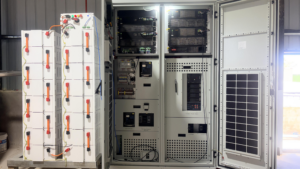
To address the specific needs of water infrastructure, YUNT offers a photovoltaic-storage-diesel microgrid system integration solution. By coordinating the operation of photovoltaic systems, energy storage, diesel generators, and intelligent control systems, this solution helps customers build a stable, efficient, and continuous power supply system.
Scenario Requirements: Ensuring the Continuous Operation of Water Infrastructure
Water treatment plant operations have distinct characteristics:
- High power demand at the moment of pump startup;
- Equipment operates for extended periods, requiring high continuity of power supply;
- Grid fluctuations can easily affect the stable operation of equipment;
- Long-term operation of diesel engines incurs high maintenance costs.
The project aims to:
- Quickly respond to the startup surge of the water pump;
- Ensure continuous operation of the water supply system;
- Improve the utilization rate of photovoltaic energy;
- Reduce the operational burden on the diesel generator set.
The traditional single-source diesel power supply model struggles to simultaneously meet the requirements for stability and cost-effectiveness, necessitating the use of a microgrid system to achieve multi-energy coordination.
System Solution: Solar-Storage-Diesel Synergy to Ensure Continuous Water Supply
YUNT provides integrated services—ranging from solution design and equipment integration to system commissioning—tailored to the operational conditions of water treatment plants.
Project Configuration:
- 250 kW energy storage system;
- 250 kW grid-forming power conversion system(PCS);
- 500 kW STS switching system;
- 120 kW PV MPPT system;
- Water utility-specific EMS energy management platform.
Through a unified energy control architecture, the system enables intelligent coordination among PV, energy storage, diesel generators, and loads.
System Operating Logic:
Normal Operating Mode:
- PV power is prioritized to meet the water treatment plant’s load;
- Excess electricity is stored for backup;
- Energy storage participates in power regulation.
During pump startup:
- The PCS rapidly delivers power;
- Smooths out the initial startup surge;
- Reduces the response pressure on the diesel generator set.
Grid Abnormalities:
- The static transfer switch(STS) rapidly completes grid-to-off-grid switching;
- Energy storage establishes a stable microgrid;
- The diesel power generation system provides coordinated power supply.
Leveraging grid-forming PCS control technology, the system maintains stable voltage and frequency even under weak grid or off-grid conditions, providing reliable assurance for the continuous operation of the water treatment plant.
At the same time, the equipment has been adapted to withstand Africa’s hot, humid, and dusty environments, meeting the requirements for long-term outdoor operation.
Project Value: Safeguarding Public Water Supply Security
Through the integration of a PV-storage-diesel microgrid, the project helps the water treatment plant move away from traditional, single-source energy supply models and enhances the resilience of its energy system.
The solution effectively improves the utilization efficiency of photovoltaic energy, reduces the operational burden on diesel generators, and enhances the water treatment plant’s ability to cope with grid fluctuations and sudden power outages.
This project demonstrates YUNT’s comprehensive capabilities in critical infrastructure, complex load adaptation, and overseas microgrid deployment, providing replicable energy solutions for public welfare scenarios in Africa, such as water utilities, hospitals, and schools.