
As European distribution networks accommodate increasingly diverse residential and commercial loads, maintaining stable power quality and supply reliability is becoming more challenging. Flexible energy storage and intelligent control can provide additional regulation capacity to address load imbalance, voltage fluctuations, and changing power demands.
Enhancing End-User Power Distribution Quality and Supply Resilience Through Flexible Energy Storage
With the continued development of distributed energy and electrification in Europe, mixed residential and commercial power supply scenarios are becoming increasingly common.
In mixed residential-commercial transformer districts in suburban areas, residential units typically have a large number of single-phase loads, while commercial users exhibit significant fluctuations in electricity consumption. The combination of these diverse load types can easily lead to issues such as uneven three-phase load distribution, voltage fluctuations, and increased line losses.
Traditional distribution upgrades primarily rely on line retrofits and transformer capacity expansion; however, in the face of decentralized and dynamic electricity demand, these traditional approaches suffer from long construction cycles and a lack of flexibility.
Tailored to European end-of-line distribution scenarios, YUNT provides flexible substation management solutions through energy storage system integration, grid-forming PCS control, and smart energy management technologies, helping customers improve power quality and optimize distribution operational efficiency.
Scenario Requirements: Addressing Distribution Challenges Posed by Mixed Residential and Commercial Loads
Mixed residential and commercial service areas in European suburbs typically exhibit the following characteristics:
- A high proportion of single-phase residential loads;
- Frequent fluctuations in commercial loads;
- Uneven load distribution leading to three-phase imbalance;
- Long feeder lines, which are prone to voltage deviations.
- The project must simultaneously meet the following requirements:
- Dynamic three-phase load balancing;
- Stable voltage regulation;
- Harmonic mitigation;
- Backup power supply during grid abnormalities.
Therefore, it is necessary to enhance the regulation capacity of the power distribution system through flexible energy equipment.
System Solution: Multi-Unit Energy Storage Clusters for Intelligent Regulation of Substations
Based on the operational characteristics of transformer districts, YUNT provides services including energy storage system design, equipment integration, grid-connection commissioning, and control strategy optimization.
Project Deployment:
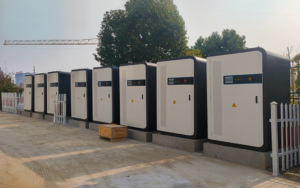
- 5 sets of 125 kW/233 kWh standardized energy storage units;
- Grid-forming PCS cluster;
- A substation-level EMS energy management platform.
Through a multi-unit energy storage cluster architecture, multiple energy storage units operate in a unified and coordinated manner, enhancing system scalability and operational flexibility.
Leveraging PCS phase-by-phase control technology, the system can make precise adjustments based on the real-time operating status of the substation:
- Dynamically balance three-phase power;
- Optimize end-of-line voltage;
- Reduce line losses;
- Improve power quality.
- At the same time, the EMS platform optimizes energy storage operation strategies in response to load fluctuations:
- Participates in peak shaving and valley filling during routine operation;
- Providing auxiliary power during peak load periods;
- Supporting critical loads during grid anomalies.
Through coordinated control of multiple devices, it avoids the uneven power distribution issues caused by the independent operation of multiple traditional energy storage units.
Project Value: Driving Flexible Upgrades in Europe’s End-of-Line Distribution
By combining energy storage solutions with smart control technology, the project helps customers enhance the operational capacity of their transformer districts without requiring large-scale modifications to the existing distribution infrastructure.
The solution not only addresses power quality issues caused by mixed residential and commercial loads but also enhances the end-of-line grid’s adaptability to renewable energy integration and load fluctuations.
This project demonstrates the evolution of energy storage systems from “energy storage devices” to “distribution regulation resources,” providing a replicable solution for upgrading mixed residential and commercial transformer districts in Europe.