
In modern manufacturing environments, the electrical infrastructure is the silent engine of productivity. Yet, many facility managers and EPC contractors are currently battling an insidious operational threat that degrades assets and inflates overhead: phase imbalance. When single-phase loads—such as precision automated assembly lines, high-draw HVAC units, or expansive LED lighting arrays—distribute power unevenly across a three-phase microgrid, the resulting voltage asymmetry does more than just flicker the lights. It actively damages distribution transformers, induces severe thermal stress, and results in premature equipment failure.
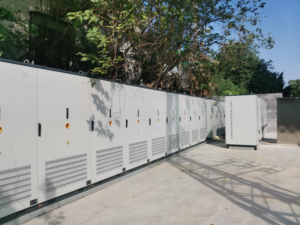
Relying on traditional, passive power correction methods is no longer a viable strategy for competitive manufacturing. As energy prices fluctuate and grid instability becomes a recurring business risk, forward-thinking operations are shifting toward the deployment of an intelligent hybrid inverter to proactively manage load distribution. By integrating these systems, facilities can shift from a reactive state of “firefighting” electrical anomalies to a strategic posture that optimizes energy efficiency, maximizes ROI, and ensures long-term operational resilience.
The Hidden Financial Drain of Three-Phase Asymmetry
For any facility manager, an unaddressed load imbalance is not merely a technical annoyance; it is a direct, compounding drain on profitability. When phases are significantly asymmetrical, excessive current is forced through the neutral wire. This phenomenon creates localized overheating and severe thermal stress on distribution transformers, effectively accelerating their wear and tear.
Beyond the hardware damage, the financial impact is felt sharply in the form of utility penalties. Utility providers are increasingly stringent, levying significant “demand charges” and surcharges on industrial consumers for poor power quality, low power factor, and reactive power draw. A factory operating under these conditions is essentially bleeding capital every month. This is why partnering with a proven hybrid power inverter supplier is essential for modern project developers. Advanced power conversion hardware can provide microsecond-level independent phase regulation, injecting or absorbing active power precisely where and when the local grid demands it. By stabilizing the voltage profile at the sub-cycle level, these systems neutralize potential utility penalties before they ever appear on a monthly invoice.
Beyond Balancing: Leveraging Peak-Valley Arbitrage
While rectifying phase asymmetry is the critical foundation for equipment longevity, modern industrial energy storage setups allow project developers to transition from defensive maintenance to offensive profit generation. The integration of high-performance energy storage into the microgrid architecture transforms the site into an active asset.
YUNT has engineered its systems specifically for this level of commercial arbitrage. By charging battery banks during off-peak hours—when industrial tariff rates are at their lowest—and discharging that energy during peak tariff windows, facilities can significantly dampen their electricity cost pressure. This strategy is highly dependent on hardware capability. With a market-leading conversion efficiency of 99%, the energy loss during charge/discharge cycles is kept to the absolute minimum. For an industrial plant executing daily arbitrage at the megawatt scale, this efficiency gain translates directly to improved profit margins and a dramatically shortened payback period for the entire storage installation.
Dynamic Capacity Expansion and Grid Resilience
A common challenge for industrial parks and high-density data centers is the limitation of existing grid infrastructure. When a facility decides to expand—perhaps by adding a new production line or a high-capacity robotic assembly unit—the cost of upgrading the main utility transformer is often prohibitive. Beyond the capital expenditure, the permitting delays and grid connection studies can stall projects for months.
Modular energy storage systems offer a far more flexible path forward. By utilizing an advanced microgrid architecture, EPCs can implement dynamic capacity expansion. The power conversion systems act as a buffer, smoothing out surges and providing the necessary surge power without requiring a complete overhaul of the facility’s electrical backbone. Because these systems are built on standardized, modular designs, project capacity can be scaled incrementally as the facility grows. This approach allows capital expenditure to be phased intelligently, ensuring that investment aligns precisely with operational needs rather than speculative future requirements.
Engineering for Extremes: Rugged Reliability
Deploying sensitive power electronics into heavy industrial environments demands a level of engineering robustness that generic hardware cannot match. Factory floors and outdoor commercial parks are high-stress environments, often characterized by extreme temperature fluctuations, constant vibration, and pervasive airborne particulates.
YUNT addresses these challenges by reducing the reliance on mechanical contact components, which significantly enhances durability and minimizes the maintenance downtime typical of traditional electromechanical components. Coupled with wide-temperature operating ranges and high ingress protection (IP) ratings, these units are designed to thrive in the harsh conditions of a modern production environment. Furthermore, with compliance across authoritative certifications from over 20 countries, project developers face no logistical barriers to global market access or grid code compliance.
Strategic Partnership for Your Power Future
Addressing enterprise electricity cost pressure requires site-specific engineering and a partner who understands the realities of high-intensity manufacturing. By combining a 30% to 40% higher power density than industry standards with exclusive network construction technology, YUNT provides the architectural backbone for the next generation of resilient industrial microgrids. Every commercial and industrial facility has unique energy requirements. Contact YUNT’s engineering team today to receive a customized microgrid solution and quotation, and discover how advanced energy storage technologies can support your project goals.