
As campuses accelerate their transition toward cleaner and more efficient energy systems, integrating renewable generation with energy storage and electric vehicle charging has become an increasingly practical approach.
Building a New Model for Integrated New Energy Applications on Campus
As the development of green campuses continues to advance, the application of renewable energy in campus parking lots is gradually shifting from the construction of standalone charging facilities toward an integrated model combining “PV + energy storage + charging + smart management.”
However, in practical applications, campus environments commonly face challenges such as limited power distribution capacity, fluctuating charging loads, and insufficient utilization efficiency of renewable energy. In traditional AC energy architectures, PV, energy storage, and charging equipment are typically deployed independently, resulting in insufficient system coordination and multiple energy conversion stages, which hinder the efficient utilization of renewable energy resources.
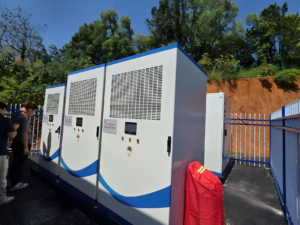
At the same time, campus energy systems involve the coordinated operation of multiple types of equipment, placing higher demands on overall solution design, system integration, and engineering commissioning capabilities.
To address the need for integrated renewable energy solutions on campuses, YUNT, as a system integrator, provides energy storage system design and integration services centered on PV, energy storage, charging, and energy management systems. By creating a DC (direct-current) microgrid solution that integrates PV, energy storage, and charging, YUNT helps campuses achieve efficient energy utilization, intelligent control, and stable operation.
Scenario Requirements: Campus New Energy Applications Face Multiple Challenges
The photovoltaic-storage-charging scenario in campus parking lots must simultaneously meet the following requirements:
- Dynamic response to the charging demands of multiple vehicles;
- Efficient consumption of green solar power;
- Optimization of power distribution capacity and load regulation;
- Energy security during grid disruptions.
Under traditional AC architectures, the lack of a unified coordination mechanism among multi-energy devices can lead to issues such as underutilization of solar power, low equipment operational efficiency, and delayed energy dispatch responses.
Therefore, the application of new energy on campus needs to shift from the construction of individual devices to system-level energy coordination, enhancing overall operational efficiency through a microgrid architecture.
System Solution: Building a PV-Storage-Charging DC Microgrid Architecture
Based on the energy consumption characteristics of the campus, YUNT completed the solution design, equipment integration, and system commissioning to build an integrated energy system comprising “PV power generation—energy storage regulation—DC charging—smart management.”
The project employs a dual 750V DC busbar architecture, integrating:
- 2 sets of 625 kW PCS control cabinets;
- a 250 kW photovoltaic system;
- a 120 kW/215 kWh energy storage system;
- DC charging equipment;
- an EMS energy management platform.
Through DC-side energy coordination, the system reduces losses associated with traditional multi-level AC-DC conversion and improves the efficiency of energy flow between the PV system, energy storage, and charging loads.
Leveraging the EMS intelligent dispatch system, the platform monitors in real time:
- PV power generation status;
- Energy storage operational status;
- Charging load fluctuations;
- grid operating conditions.
- It dynamically optimizes energy allocation based on different operating conditions:
- Prioritize PV power to meet charging demand;
- Excess electricity is stored for backup;
- Energy storage provides supplementary power during peak periods;
- Provides energy support during abnormal conditions.
Project Value: Promoting the Smart Upgrade of the Campus Energy System
Through the integration of a photovoltaic-storage-charging DC microgrid system, the project achieves efficient coordination among the production, storage, and consumption of renewable energy.
The solution not only improves the utilization efficiency of photovoltaic energy but also optimizes the operational load on the campus power distribution system, while enhancing the flexibility and reliability of the energy system.
This project demonstrates the potential of DC microgrids in campus renewable energy scenarios and provides a reference for energy storage system solution and integration in educational campuses, public buildings, and similar settings.