
As distributed energy resources continue to expand across Europe, distribution areas are facing increasingly complex and variable power demands. Cultural and tourism parks are a typical example, where residential, commercial, and public-service loads can change significantly by season and time of day. In these environments, flexible energy storage can provide an alternative to relying solely on conventional grid expansion, helping distribution systems respond more effectively to load fluctuations, power quality requirements, and emergency power needs.
Enhancing Power Supply Resilience in Complex Distribution Areas with Flexible Energy Storage
With the rapid development of distributed energy in Europe, traditional distribution networks are facing new operational challenges.
In mixed-load scenarios such as cultural and tourism parks and resort communities, residential electricity consumption, commercial operations, and public service facilities often coexist, resulting in more complex load variations. This can easily lead to issues such as high transformer loads, three-phase imbalance, voltage fluctuations, and increased line losses.
Traditional solutions typically rely on grid expansion and infrastructure upgrades, which not only involve lengthy construction cycles and high investment costs but also struggle to flexibly accommodate future load growth.
Addressing the complex energy demands of European distribution transformer districts, YUNT provides commercial energy storage solutions through energy storage system integration, power quality management, and intelligent control strategies. These solutions help customers improve the operational efficiency of their distribution systems and achieve an integrated approach to stable power supply, load regulation, and optimization.
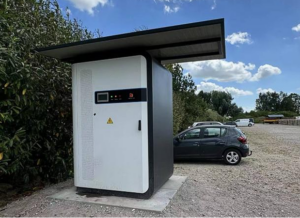
Scenario Requirements: Operational Challenges in Distribution Areas with Complex Loads
Hybrid cultural and tourism service areas in Europe typically exhibit the following characteristics:
- Pronounced seasonal and cyclical load fluctuations;
- Simultaneous operation of multiple load types, including residential and commercial;
- Increased integration of renewable energy sources places additional demands on grid regulation capacity;
- Traditional distribution system capacity expansion struggles to respond quickly to demand fluctuations.
The project must simultaneously address:
- Operational stress on transformers;
- Three-phase load imbalance;
- voltage fluctuations;
- power supply reliability during emergencies.
Therefore, it is necessary to enhance the substation’s regulation capacity through flexible energy equipment, rather than relying solely on traditional grid upgrades.
System Solution: Energy Storage + Grid-Forming PCS for Flexible Regulation of Substation Areas
As a system integration service provider, YUNT has designed the energy storage system, integrated the equipment, and optimized control strategies based on the operational characteristics of the substation.
The project employs a proprietary three-phase, four-arm 125 kW grid-forming PCS as the core equipment, integrating:
- Energy storage system;
- an EMS energy management platform;
- Outdoor Low-Voltage Power Distribution Unit;
- Smart control system.
Through the coordinated operation of energy storage and the power grid, the system achieves multiple functions, including peak shaving and valley filling, power quality management, and emergency power supply.
Leveraging the PCS’s phase-by-phase regulation capability, the system can:
- adjust the three-phase power distribution in real time;
- mitigate load imbalance;
- Optimize reactive power management;
- Enhance end-point voltage stability.
At the same time, by integrating EMS smart strategies, it optimizes energy storage operations based on changes in the park’s load and electricity pricing mechanisms:
- Charge the energy storage system during periods of low load;
- Discharge energy during peak periods;
- Provide backup support during grid anomalies.
The equipment features a modular design to meet the requirements of outdoor environments in Europe, supporting rapid deployment and future expansion.
Project Value: Creating a New Model for Energy Storage Management in European Substations
Through the integration of flexible energy storage solutions, the project helps customers reduce their reliance on traditional grid expansion and enhances the operational flexibility of distribution areas.
The solution not only enhances power supply stability but also improves power quality, providing a more efficient energy management approach for complex load scenarios such as cultural and tourism parks.
This project demonstrates the value upgrade of energy storage systems from “peak-shaving and valley-filling equipment” to “distribution system regulation units,” providing a replicable substation management solution for distributed energy scenarios in Europe.