
Industrial manufacturing facilities, massive logistics hubs, and commercial office parks are navigating a highly volatile energy landscape. Rising peak-hour tariffs, localized power restrictions, and unexpected grid dropouts threaten operational continuity and squeeze corporate margins. To shield themselves from these vulnerabilities, forward-thinking EPCs and industrial developers are rapidly installing on-site microgrids. However, merely storing energy for self-consumption represents only a fraction of a modern asset’s financial potential. Through Virtual Power Plant (VPP) integration, commercial operators can transform their energy storage systems from simple cost-saving backup units into active, revenue-generating grid assets. Executing this transition successfully requires highly sophisticated control hardware. Industry leaders are turning to YUNT to provide the reliable, responsive grid-tied infrastructure necessary to participate in these lucrative dynamic energy markets.
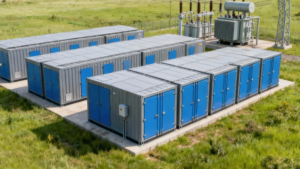
A VPP aggregates decentralized energy resources—including industrial photovoltaic arrays, backup generators, and commercial battery systems—into a single cloud-managed network. This aggregated capacity can be dispatched in real-time to stabilize the utility grid, participate in demand response programs, or sell power back during peak demand windows. For procurement and supply chain managers, the primary objective is to maximize the ROI of these capital investments while minimizing the impact on factory operations. To achieve this, the underlying power electronics must handle bidirectional energy flows with microsecond precision, translating cloud commands into physical grid actions without introducing performance bottlenecks.
At the intersection of the localized factory network and the macro-grid is the energy storage inverter. Standard utility-tied cabinets are often too slow to respond to VPP dispatch signals, leading to missed revenue opportunities or compliance penalties. For high-stakes industrial applications, specifying a highly responsive BESS power conversion system is critical. This specialized equipment serves as the primary gateway, translating complex grid signals into automated battery charging and discharging sequences. When the VPP platform demands sudden frequency regulation or rapid peak shaving, the power conversion cabinet must react instantly, injecting or absorbing reactive power to stabilize the substation’s dynamic capacity.
Optimizing Your Battery Power Conversion System for Peak-Valley Arbitrage
In commercial environments, every fractional percentage of efficiency directly impacts the bottom line. Traditional power conversion designs suffer from noticeable thermal and switching losses, which quickly erode the profitability of frequent VPP dispatch cycles. Advanced engineering overcomes these limitations by integrating high-efficiency components. Modern hardware delivers an outstanding conversion efficiency of 99%, ensuring that nearly every kilowatt-hour of energy harvested or stored is successfully commercialized. By minimizing conversion losses, industrial operators can execute highly profitable peak-valley arbitrage strategies, charging their arrays when utility rates are low or negative, and discharging to the local facility or VPP network during the most expensive peak periods.
Beyond efficiency, physical spatial constraints in commercial parks and factories require extremely compact equipment layouts. R&D teams, staffed by a high proportion of master’s-level professionals, have designed modular architectures that deliver a power density 30% to 40% higher than traditional competitors. This exceptional power density allows project developers to maximize local storage capacity without sacrificing valuable manufacturing floor space or expansion yard footprint. Standardized, mass-produced modules also guarantee high project implementation efficiency and stable delivery timelines, allowing EPCs to bring VPP-ready installations online with minimal delay.
Technical Resilience and Global Compliance in Complex Grid Scenarios
Participating in a VPP subjects power electronics to continuous stress. Unlike backup-only systems that remain idle for most of the year, a VPP-integrated system operates under continuous, dynamic cycling. This rigorous duty cycle demands unmatched hardware durability. Standard contactors are highly prone to mechanical sticking and physical degradation under continuous high-frequency switching. To solve this, leading designs utilize a no mechanical contact design, which drastically minimizes mechanical wear, lowers long-term maintenance overhead, and ensures uninterrupted performance. Coupled with a wide operating temperature range and robust ingress protection, this ensures the hardware remains completely isolated from harsh external environments, whether deployed in dry industrial zones or humid coastal plains.
Furthermore, global distributors and multinational EPCs must navigate a complex web of local grid codes and international standards. A system that cannot clear regulatory hurdles represents a stranded asset. Specifying high-protection equipment that carries authoritative compliance certifications from over 20 countries guarantees smooth, barrier-free global market access. This certified compatibility ensures that whether your project is operating under North American IEEE rules, European EN standards, or regional grid codes, the hardware is ready to sync and trade power on any regional VPP platform.
Activating Your Commercial Microgrid Assets
Transitioning to a dynamic, revenue-generating microgrid requires a reliable, highly optimized battery power conversion system that bridges the gap between local enterprise needs and utility-scale dispatch. Integrating advanced hardware ensures your commercial facility can combat power restrictions, reduce demand charges, and unlock secondary revenue streams through VPP coordination. Our fast-response engineering capabilities can deliver fully customized microgrid solutions within 72 hours, perfectly tailored to your local grid conditions, spatial limitations, and specific commercial targets.
Protect your operational continuity and maximize the ROI of your new energy investments. Contact us today to request a customized microgrid quote and learn how our high-density, high-efficiency systems can optimize your enterprise’s power strategy.