
As renewable energy deployment expands across the Middle East, integrating solar power generation, energy storage, and electric vehicle charging into a single energy system is becoming increasingly important. However, renewable energy projects in this region must operate under demanding conditions, including high ambient temperatures, strong solar radiation, and limited or unstable grid infrastructure. These factors place higher requirements on energy conversion, power coordination, and system control.
Building a Highly Reliable Renewable Energy Supply System for High-Temperature, Weak-Grid Environments
The Middle East region is rich in solar resources and holds immense potential for renewable energy applications; however, during the implementation of actual projects, renewable energy systems still face numerous challenges due to local grid infrastructure, climatic conditions, and O&M constraints.
In environments characterized by high temperatures, intense sunlight, and weak grid infrastructure, traditional renewable energy systems are prone to issues such as reduced equipment efficiency, insufficient energy coordination, and operational instability. Additionally, photovoltaic, energy storage, and charging equipment typically operate in isolated architectures, lacking a unified dispatch mechanism among multiple devices, which hinders the full realization of the renewable energy system’s value.
To address the complex energy application needs in the Middle East, YUNT leverages its proprietary power control technology and system integration capabilities to develop a flexible microgrid solution featuring a shared DC bus for PV, energy storage, and charging. This solution enables deep synergy among PV, energy storage, charging, and energy management systems, helping customers build new energy stations that are efficient, stable, and adaptable to extreme environments.
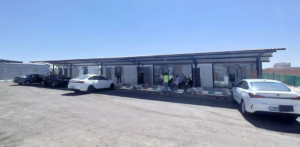
Scenario Requirements: Addressing Energy Challenges in High-Temperature, Weak-Grid Environments
Outdoor renewable energy scenarios in the Middle East typically exhibit the following characteristics:
- Prolonged operation in high temperatures, placing high demands on equipment’s weather resistance;
- Limited grid infrastructure, requiring enhanced system stability;
- Significant fluctuations in PV output, requiring improved renewable energy integration capacity;
- Complex coordination among multiple types of equipment, necessitating unified energy management.
Traditional AC-coupled solutions suffer from issues such as multiple energy conversion stages and insufficient equipment coordination, making it difficult to fully leverage system performance in weak grid environments.
Therefore, the project requires a more flexible energy architecture to achieve efficient utilization of renewable energy and stable system operation.
System Solution: Shared DC Bus Architecture Enhances Energy Coordination Efficiency
Based on the project’s operational requirements, YUNT provides an integrated solution covering system design, equipment integration, and on-site commissioning.
The project adopts a shared DC bus flexible microgrid architecture, integrating:
- 4 grid-forming 125 kW power conversion system(PCS) units;
- 4 units of 60 kW PV MPPT charge controllers;
- 5 units of 160 kW DC charging equipment;
- an energy storage system and a smart energy management platform.
Through DC-side energy interconnection, the project reduces the number of traditional multi-level conversion stages, enabling efficient coordination among PV generation, energy storage regulation, and charging loads.
The system is equipped with an intelligent EMS energy management platform that performs real-time analysis of PV output, energy storage status, and load demand, and dynamically adjusts energy strategies based on operating conditions:
- Prioritize PV power to meet load demand;
- Excess electricity is stored for backup;
- Energy storage participates in power regulation;
- Maintains stable system operation in off-grid conditions.
- At the same time, leveraging the grid-forming capabilities of the PCS, the system achieves:
- Active bus voltage support;
- Coordinated power control among multiple devices;
- Stable operation in weak grid environments;
- Autonomous grid formation in off-grid mode.
These capabilities meet the requirements for long-term operation in the Middle East’s high-temperature, weak-grid, and complex outdoor environments.
Project Value: Developing a New Energy Microgrid Solution Tailored to the Middle Eastern Market
Through system-level integration, the project has upgraded renewable energy equipment from standalone operation to coordinated operation, improving photovoltaic utilization efficiency and system operational stability.
Compared to traditional energy infrastructure approaches, this solution reduces the complexity of integrating multiple devices, enhances system scalability, and improves the adaptability of renewable energy sites to complex grid environments.
This project has validated the application value of the shared DC bus flexible microgrid architecture in overseas renewable energy scenarios, providing a replicable solution for integrated PV-storage-charging applications in the Middle East.