
As distributed solar capacity continues to grow in rural Europe, high PV penetration can create challenges such as excess generation, reverse power flow, and voltage fluctuations. Flexible energy storage can help absorb surplus solar power and improve the stability and utilization of local renewable energy.
Enhancing Rural Renewable Energy Integration Through Energy Storage Regulation Capabilities
With the rapid development of distributed solar power in Europe, more and more rural areas are beginning to deploy rooftop solar systems and small-scale solar power plants. However, in some regions with high solar penetration rates, the concentrated output from solar power does not match local demand, which can easily lead to reverse power flow, voltage fluctuations, and limitations on the integration of renewable energy.
Particularly in rural grid scenarios, where distribution lines are long and regulatory capacity is limited, when daytime PV generation exceeds local load demand, a large amount of surplus electricity must be transmitted to the higher-level grid, placing higher demands on the operation of the distribution system.
For scenarios involving high proportions of renewable energy integration, YUNT helps customers improve PV utilization efficiency, enhance regional energy regulation capabilities, and build a more flexible and reliable new energy system through the integration of PV-storage microgrids, grid-forming PCS control, and intelligent energy management strategies.
Scenario Requirements: Addressing Operational Pressures Caused by High-Proportion PV Integration
Rural areas in Europe with high concentrations of PV installations typically face the following challenges:
- PV generation is concentrated during the day, while load absorption capacity is limited;
- Excess power being fed back into the grid, increasing the load on the distribution system;
- Fluctuations in renewable energy affecting grid stability;
- The need to ensure power supply reliability during extreme weather events.
- The project must simultaneously achieve:
- Efficient utilization of photovoltaic power;
- Reduce the risk of curtailed renewable energy;
- Smoothing out fluctuations in renewable energy output;
- Enhancing rural communities’ energy self-sufficiency.
Traditional approaches primarily rely on grid expansion and line upgrades, but these involve long construction cycles and high investment costs, making it difficult to flexibly address the continuously growing demand for renewable energy integration.
System Solution: Solar-Storage Synergy to Enhance Renewable Energy Utilization Efficiency
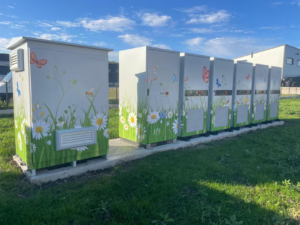
Based on the characteristics of renewable energy applications in rural areas, YUNT provides a comprehensive energy storage system solutions for photovoltaic-storage microgrids, covering system design, equipment integration, and optimization of operational strategies.
Project Configuration:
- 2 sets of 125 kW/289 kWh energy storage systems;
- PV-synchronous MPPT devices;
- Grid-forming PCS;
- EMS (Intelligent Energy Management System) platform.
Through coordinated control among PV, energy storage, and the utility grid, the system optimizes the entire process of renewable energy production, storage, and consumption.
Based on EMS’s intelligent dispatch strategies, the system dynamically adjusts its operating mode according to changes in PV output and load:
During daytime PV peak hours:
- Prioritize meeting local load demand;
- Excess electricity is fed into the energy storage system;
- Reduces the pressure of reverse power flow from renewable energy sources.
- At night and during peak periods:
- Discharge energy from the energy storage system;
- Reduce peak electricity purchase demand;
- Enhance the value of renewable energy utilization.
- In the event of grid abnormalities:
- The PCS enters grid-forming mode;
- Autonomously maintains voltage and frequency stability;
- Provide backup power support for critical loads.
Additionally, the system is designed with protection features tailored to European outdoor environments to ensure long-term, stable operation.
Project Value: Establishing a New Energy Model for Areas with High Renewable Energy Penetration
Through the integration of photovoltaic-storage microgrids, the project helps rural areas enhance their capacity to absorb solar power and reduces the strain on distribution systems caused by the integration of renewable energy.
The energy storage solution not only improves the efficiency of local renewable energy utilization but also enhances the resilience of the regional energy system in the face of extreme weather and grid fluctuations.
This project demonstrates the value upgrade of energy storage from “supporting equipment for renewable energy” to “flexible grid regulation resources,” providing a replicable solution for the energy transition in European regions with high photovoltaic penetration rates.