
In weak-grid environments, commercial and industrial users need to balance power reliability, renewable energy utilization, and backup generation. Coordinating solar, energy storage, utility power, and diesel generation through a unified microgrid can provide more flexible and reliable energy management.
Building a Stable and Efficient Multi-Energy Power Supply System for Weak Grid Environments
In some parts of Southeast Asia, due to grid infrastructure limitations and energy supply constraints, commercial and industrial users continue to face issues such as power outages, voltage fluctuations, and insufficient power supply stability.
For continuous production scenarios such as manufacturing enterprises and industrial parks, frequent power disturbances not only affect equipment operational efficiency but may also lead to production interruptions and operational losses.
At the same time, an increasing number of enterprises are deploying photovoltaic, energy storage, and diesel power generation systems. However, since different energy devices are typically installed independently and lack a unified control strategy, issues such as low energy utilization efficiency, difficulties in device coordination, and complex operation and maintenance often arise.
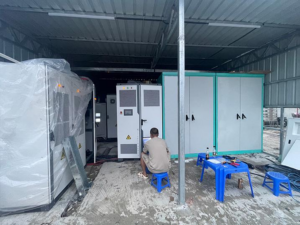
For commercial and industrial scenarios in weak grid environments, YUNT leverages its microgrid system integration capabilities to achieve unified coordination among PV, energy storage, utility power, and diesel generators. Through grid-forming PCS power conversion systems, STS switching systems, and the EMS energy management platform, we help customers build stable, efficient, and flexible multi-energy microgrid systems.
Scenario Requirements: Addressing Energy Supply Challenges in Weak Grid Environments
Commercial and industrial users in Southeast Asia typically face:
- Insufficient stability of the utility grid supply;
- Voltage fluctuations affecting production equipment;
- PV, energy storage, and diesel generators operating independently;
- Lack of unified dispatch among multiple energy sources.
The project aims to achieve:
- Coordinated operation of multiple energy sources;
- Rapid response to grid fluctuations;
- Uninterrupted power supply to critical loads;
- Efficient utilization of photovoltaic energy.
Traditional single-source backup power models struggle to balance energy cost optimization and power supply reliability, necessitating an upgrade in overall energy management capabilities through a microgrid architecture.
System Solution: Building a Smart Microgrid Through the Synergy of PV, Storage, and Diesel
YUNT provides integrated services—ranging from system design and equipment integration to on-site commissioning—tailored to the operational needs of industrial users.
Project Integration:
- 375 kW grid-forming PCS cabinet;
- 360 kW PV MPPT system;
- 500 kW STS switching system;
- Energy storage battery system;
- EMS Energy Management Platform.
Through a unified energy control architecture, PV, energy storage, utility power, and diesel generators are integrated into a single energy management system.
The EMS intelligently optimizes energy strategies based on different operating conditions:
Normal power supply mode:
- PV generates power to meet load demand first;
- Excess energy is stored;
- Energy storage participates in load regulation.
During periods of high load:
- Energy storage responds rapidly to power fluctuations;
- Reduces the load on diesel engines;
- Smooths out equipment startup surges.
Grid Abnormalities:
- The STS rapidly completes grid connection and disconnection switching;
- The PCS provides stable power support;
- The diesel generator system operates in coordination as a backup power source.
Leveraging VSG grid-forming control technology, the system enhances voltage and frequency stability in weak grid environments and improves adaptability to industrial loads.
Project Value: Enhancing Industrial Energy Resilience in Southeast Asia
Through the integration of a multi-energy microgrid combining solar, storage, and diesel power, the project helps customers transition from a traditional single-energy supply model to a smart, coordinated energy system.
The solution improves the utilization efficiency of renewable energy, reduces the operational burden on diesel generators, and simultaneously enhances production reliability in the face of grid fluctuations and power outage risks.
This project demonstrates YUNT’s comprehensive capabilities in overseas weak grid applications, multi-energy coordination, and industrial microgrid deployment, providing a reliable path for energy upgrades in Southeast Asian manufacturing and industrial parks.