
South African medium and large commercial farms face significant challenges from frequent power outages and the need for reliable electricity to support irrigation, cold-chain operations, sorting, and packaging. For these agricultural projects, properly designed energy storage system solutions can help maintain critical operations while avoiding unnecessary investment in oversized battery capacity. This article explores how load segmentation and coordinated water and electrochemical energy storage can reduce battery sizing pressure in a 2.2MW solar and storage solution.
The Engineering Pitfall of Frequent Load Shedding and Blind Expansion
The routine load shedding of South Africa’s national power utility, Eskom, is seriously threatening local high-value export agriculture. Once citrus, avocado, and other farms suddenly lose power, irrigation stops, fruit sorting lines become inoperable, and 24-hour cold-chain operations are interrupted, resulting in irreversible economic losses.
Faced with this challenge, many project owners can easily fall into an engineering misconception: trying to withstand the entire nighttime electricity load of the farm by continuously increasing the capacity of battery energy storage systems (BESS).
Blindly adding batteries can significantly increase the project’s initial capital expenditure (CAPEX), directly reduce the internal rate of return (IRR), and ultimately cause farm owners to put the project on hold because of excessive costs.
Core Solution: Load Segmentation and Coordinated Water and Electrochemical Dispatch
Farm loads have highly flexible characteristics, especially irrigation water pumps, which consume large amounts of electricity. For farms with suitable terrain conditions, YUNT can adopt a mature engineering approach that combines an elevated water reservoir with coordinated solar and energy storage dispatch.
Daytime direct solar power and hydraulic energy storage: When there is surplus solar power during the day, high-power water pumps are scheduled to operate at full load and pump water to an elevated reservoir.
Nighttime gravity-fed irrigation with zero electricity consumption: At night, the water pumps are no longer started. The elevation difference is used to achieve gravity-fed irrigation.
Batteries dedicated to rigid loads: Expensive battery energy storage is used only to ensure the operation of non-interruptible loads, such as cold storage, control systems, security lighting, and some sorting and packaging lines.
Through load segmentation, the large energy regulation requirement can be handled by hydraulic energy storage, significantly reducing the capacity pressure on the energy storage system and greatly improving the project’s financial feasibility. This approach can also be incorporated into commercial energy storage solutions according to the specific load characteristics and operating requirements of the farm.
Customized 2.2MW Solar and Energy Storage Architecture
Based on the farm’s load profile and production schedule, we provide a standardized electrical hub design:
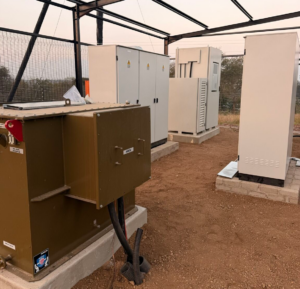
80–120 hectare farms (2.2MW solar and energy storage solution): The solution mainly covers daytime irrigation, sorting and packaging, and basic cold-chain loads.
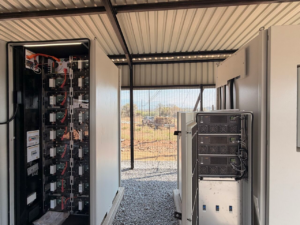
Within the system, the PCS energy storage converter serves as the core power hub and dynamically adjusts operation in real time according to photovoltaic output and battery SOC. When the grid is operating normally, it enables coordinated grid-connected operation of solar power and energy storage. At the moment of a power outage, the PCS with built-in grid-forming technology rapidly establishes the microgrid voltage and frequency, ensuring the continuous operation of critical loads.
As a global microgrid electrical solution provider, YUNT provides EPC contractors and developers with a complete engineering foundation, including modular PCS hardware, EMS dispatch logic, load segmentation solutions, and system electrical topologies. Customers only need to leverage their own local delivery capabilities and resources while entrusting the underlying complex power conversion and control challenges to us. In this way, they can deliver resilient energy systems that combine economic efficiency with high reliability.
The solution can also be integrated into industrial energy storage systems and a hybrid microgrid system based on specific project requirements, while the PCS serves as the core power conversion system connecting different energy and load resources.
Planning a solar and energy storage project for a commercial farm in South Africa? Connect with the YUNT engineering team to discuss your load profile, irrigation requirements, and grid conditions. For project consultation and solution support, reach us on WhatsApp (+86 137 1503 3530).