
As commercial and industrial photovoltaic installations continue to expand across Bulgaria and Eastern Europe, a growing gap can emerge between solar generation and on-site electricity demand. When midday PV output exceeds a facility’s consumption and grid export is restricted, energy storage can play a critical role in absorbing surplus generation and preventing unwanted power flow back to the grid.
The Solar Consumption Trap and Forced Curtailment Risk in Eastern Europe
In Bulgaria and the broader Eastern European commercial and industrial market, the acceleration of the energy transition has driven rapid growth in rooftop photovoltaic installations. However, many EPCs discover an awkward “consumption trap” after project delivery: during the strongest midday sunlight, the peak output of the PV array can far exceed the facility’s own electricity demand.
Because some public grid infrastructure in the region is relatively weak, grid companies impose extremely strict capacity limits on reverse power flow from businesses, meaning the export of surplus electricity to the grid may even be prohibited entirely. When a facility cannot fully consume its midday solar generation and excess electricity flows uncontrollably back into the grid, grid protection equipment can trigger forced PV shutdown.
This not only disrupts the facility’s power system but also means that a significant amount of the photovoltaic generation capacity that the company has invested heavily in is wasted during the most productive hours of the day.
For this type of application, energy storage system supplier capabilities can provide the basis for coordinating surplus PV generation with on-site demand and grid requirements.
Core Solution: Peak Shifting and Millisecond-Level Reverse Power Control
Here, the energy storage system is no longer simply a backup power source. Instead, it becomes a core power conversion hub for protecting the return on investment of the photovoltaic asset. Its engineering value can be understood at two progressive levels.
Solar consumption and energy arbitrage through peak shifting: Large amounts of surplus PV electricity that cannot be consumed at midday can be efficiently stored in the battery array through the PCS power conversion system. The stored energy can then be released at night when electricity prices are higher or during peak load periods, enabling energy to be shifted across time and supporting electricity cost optimization.
Closed-loop reverse power control: This is a core function of the energy storage EMS. The system monitors the facility’s total load, PV inverter output, and the direction of power flow at the point of common coupling (PCC) at a very high frequency. Once it detects a trend toward reverse power flow to the grid, it immediately instructs the PCS to increase charging power and absorb the surplus electricity. If the battery is already fully charged, the system then coordinates the disconnection of some PV strings. This creates a “zero backfeed” closed loop at the grid level.
1MW-Class Distributed Modular Expansion
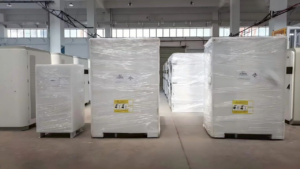
In a 3MW ground-mounted PV coordination project in Bulgaria, we deployed a 1000kW/2312kWh large-scale energy storage system. The system uses eight 125kW PCS cabinets connected in distributed parallel.
This “building-block” architecture not only ensures conversion efficiency of up to 98.9% for a single unit, but also allows companies to configure the system according to their current load during the initial stage and gradually add capacity as the factory expands in the future, avoiding excessive upfront investment.
At the same time, all equipment must strictly comply with stringent European grid connection standards and grid code certification requirements.
A Solid Foundation for Global Project Partners
As a provider of microgrid electrical hub solutions, YUNT Power has accumulated practical project experience across global markets. Our equipment and solutions have been successfully deployed in dozens of countries across Europe, including the United Kingdom, Germany, Spain, Italy, the Netherlands, Belgium, Switzerland, Austria, the Czech Republic, Slovenia, Romania, Bulgaria, Moldova, Ukraine, Poland, Lithuania, Latvia, Estonia, Finland, Sweden, Denmark, Hungary, and Cyprus; Africa, including South Africa, Nigeria, Zambia, Zimbabwe, Madagascar, and Cameroon; the Middle East and Asia-Pacific, including Yemen, Jordan, Palau, India, Myanmar, South Korea, Thailand, Vietnam, Malaysia, Singapore, and the Philippines; as well as South America, including Brazil.
We provide a complete engineering foundation covering modular PCS hardware, EMS dispatch logic, load-splitting solutions, and system electrical topology. Customers can focus on their local delivery capabilities and resources while relying on us to address the underlying challenges of power conversion and control, making it easier to deliver resilient energy systems that balance economic efficiency with high reliability.
If your PV project faces limits on grid export, let YUNT help you assess how storage capacity, PCS configuration, and EMS control can work together for the site’s actual operating conditions. Contact us via WhatsApp (+86 137 1503 3530) to discuss your project requirements.