
In tropical island countries such as Indonesia and the Philippines, coastal industrial parks and independent island microgrid projects face unique environmental challenges. Long-term exposure to high temperatures, high humidity, and salt spray corrosion can place significant demands on power electronics equipment. For these projects, an energy storage inverter must be designed and selected with long-term environmental reliability in mind.
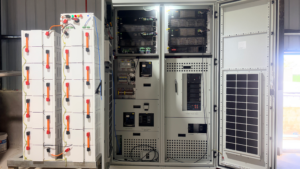
The Chronic Threat to Island Microgrids: Long-Term Environmental Corrosion
In tropical archipelagic countries such as Indonesia and the Philippines, coastal industrial parks and independent island microgrid projects face extremely demanding natural conditions. There are no extreme cold or high-altitude conditions here, but persistent high temperatures, high humidity, and high concentrations of salt spray create a form of “chronic attack” on power electronics equipment.
For energy storage power conversion systems (PCS), the greatest engineering risk is often not a one-time short-circuit incident but years of continuous environmental exposure. High temperatures reduce the temperature difference available for heat dissipation inside the equipment, making power derating more likely. Large day-night temperature variations combined with high humidity can easily cause condensation on circuit boards, leading to short circuits. Meanwhile, salt spray carried inland by sea winds can form a conductive corrosion layer on metal terminals and sensitive components. This can eventually result in insulation degradation, equipment failure, or even unexpected fires.
In tropical coastal projects, the real test for equipment is not its peak power rating under laboratory conditions, but its ability to operate reliably and continuously for up to ten years.
Core Solution: High Protection Ratings and Intelligent Liquid Cooling
When selecting PCS for demanding tropical island conditions, power and efficiency cannot be the only considerations. Environmental adaptability must be treated as a primary selection criterion, especially for industrial energy storage systems expected to operate continuously in hot, humid, and corrosive environments.
IP66 physical protection: The protection rating is the first physical barrier against salt spray and moisture. The Mars series PCS provides a high level of dust protection and resistance to water spray. However, high protection does not simply mean “sealing” the cabinet. Physical isolation must be carefully balanced with internal heat dissipation.
Dual liquid-cooling and air-cooling architecture: For conventional load conditions, we provide an air-cooled solution with a simple structure and enhanced anti-corrosion coating. For heavy-load applications that require continuous full-power operation at high temperatures, YUNT’s main liquid-cooled PCS offers significant advantages. The liquid-cooling system efficiently removes heat from power devices such as IGBTs, helping maintain output without derating under high equatorial temperatures. More importantly, because the internal and external air are isolated, it prevents salt spray and moisture from entering the equipment’s core compartments.
Simplified topology and medium-voltage integration: The hardware supports a transformerless topology, significantly simplifying the electrical path of the system. For large industrial parks that need to connect to medium-voltage grids, a dedicated anti-corrosion step-up transformer can be provided for system integration.
As a microgrid electrical hub solution provider, YUNT Power’s practical projects have been deployed around the world. Our equipment and solutions have successfully served dozens of countries across Europe, including the United Kingdom, Germany, Spain, Italy, the Netherlands, Belgium, Switzerland, Austria, the Czech Republic, Slovenia, Romania, Bulgaria, Moldova, Ukraine, Poland, Lithuania, Latvia, Estonia, Finland, Sweden, Denmark, Hungary, and Cyprus; Africa, including South Africa, Nigeria, Zambia, Zimbabwe, Madagascar, and Cameroon; the Middle East and Asia-Pacific, including Yemen, Jordan, Palau, India, Myanmar, South Korea, Thailand, Vietnam, Malaysia, Singapore, and the Philippines; and South America, including Brazil.
We provide a complete engineering foundation covering modular PCS hardware, EMS dispatch logic, load-splitting solutions, and system electrical topology. Customers can leverage their local delivery and resource advantages while entrusting complex power-conversion control challenges to us, helping them deliver resilient energy systems that balance economic efficiency with high reliability.
When tropical coastal conditions place additional demands on equipment protection and long-term reliability, YUNT is available to discuss the appropriate microgrid configuration for your project. Contact us via WhatsApp (+86 137 1503 3530) to share your application requirements.