
For water treatment plants, industrial facilities, high-end resorts, and telecommunications sites in remote areas of Madagascar, unstable public-grid power can pose a major risk to continuous operations. A properly designed microgrid can bridge the gap between grid outages and traditional backup generation, helping critical loads maintain a stable power supply.
Grid Outages and the Weakness of Traditional Backup Power
Madagascar’s public grid varies significantly across different regions. For water treatment plants, processing facilities, high-end resorts, and telecommunications base stations far from major cities, power outages are one of the biggest sources of uncertainty in daily operations. To address this problem, most businesses have diesel generators configured as backup power sources.
However, traditional diesel backup systems have a critical physical weakness: startup delay. When the public grid suddenly fails, the diesel generator typically needs several seconds or even tens of seconds to detect the outage, start, warm up, and finally deliver stable power. During this gap, water treatment pumps and valves, precision refrigeration compressors, and core industrial control equipment can experience a complete power interruption and restart.
For processes that require a high level of continuity, even a power outage lasting only a few seconds can interrupt the entire process chain, cause data loss, or result in the scrapping of expensive materials.
For such applications, energy storage system design needs to account for not only available backup capacity but also how different power sources can work together during grid interruptions.
Core Solution: Millisecond-Level Switching and an Uninterrupted Microgrid Architecture
The emergence of microgrid systems can effectively fill this critical “power interruption gap.” A well-designed microgrid electrical hub can deeply integrate PV, energy storage, diesel generators, and the public grid.
When the grid is operating normally, the system operates in grid-connected mode. PV takes priority in supplying critical loads, while the energy storage system smooths fluctuations and stores electrical energy.
When a grid fault occurs, the energy storage system responds rapidly. The integrated STS (static transfer switch) can disconnect the main grid connection and achieve rapid power-source switching at less than 10 milliseconds (<10 ms). This switching speed is even faster than a human blink, helping ensure that critical loads experience no interruption in power supply.
Only when the outage continues for a longer period and the energy storage SOC (state of charge) falls to the preset safety threshold does the system automatically start the diesel generator to continue supplying power.
For remote sites without a reliable public grid, the system can instead operate directly in a fully off-grid microgrid mode. Rather than relying on energy storage to withstand every operating period, the system optimizes the operating schedule of the diesel generator so that it starts only during heavy-load periods or extended periods of rainy weather.
4 × 125kW Benchmark Configuration and Solution Support
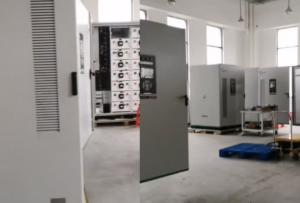
Taking a typical water treatment plant or off-grid project already implemented in Madagascar as an example, the system is configured with four 125kW energy storage PCS units and four 250kW high-capacity STS modules.
The PCS units perform complex energy storage power conversion and provide electrical support for the microgrid, while multiple STS units connected in parallel establish a robust power-supply protection layer within the multi-source network.
In this architecture, PCS module technology forms part of the power conversion structure that connects energy storage with the microgrid, supporting the coordinated operation of the system’s different power sources.
For EPC contractors and project development partners worldwide facing similar challenges, YUNT provides field-tested hardware hubs and microgrid control strategies. We integrate the core technology for seamless switching between grid-connected and off-grid operation into standardized cabinets, helping partners deliver energy systems designed to maintain the continuous operation of critical equipment such as water pumps, refrigeration systems, and industrial control equipment.
This approach helps avoid the economic losses caused by production downtime. For projects that also require energy storage system installation, YUNT can provide a solution framework centered on the required microgrid architecture and power-source coordination.
If your water treatment plant, industrial facility, or remote site faces frequent grid interruptions, discuss your application requirements with YUNT via WhatsApp (+86 137 1503 3530) to explore a suitable microgrid configuration.