
In oilfield operations, reliable power is about more than simply having electricity available. Workover and hydraulic fracturing operations can involve large power-consuming equipment running at the same time, while the load can change rapidly within a short period. For some well sites, the existing grid capacity cannot meet these demands, making diesel and gas generator sets important sources of on-site power.
This is where hybrid power inverter solutions can become part of a more flexible mobile energy system, particularly when energy storage needs to work alongside conventional generation.
Why Traditional Generators Struggle with Rapidly Changing Oilfield Loads
When loads begin to change rapidly, the limitations of traditional generator sets can become increasingly apparent. Generator sets have limited mechanical response speeds. When high-power equipment starts suddenly or the load increases rapidly, the generator needs time to adjust its output. In weak-grid or standalone power scenarios, these power changes can further appear as fluctuations in AC bus voltage and frequency.
Simply adding more generator sets to increase available capacity also means that more equipment needs to be configured and maintained over the long term. However, oilfield operations are highly mobile and occur in distinct stages, so the equipment does not necessarily operate at full load all the time.
This is one reason why mobile energy storage is beginning to enter oilfield applications.
Mobile Energy Storage Is Not Simply a Replacement for Diesel Generators
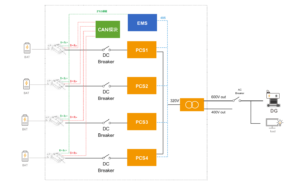
To address the high-power and rapidly fluctuating load characteristics of oilfield operations, YUNT Power adopts an architecture combining a mobile energy storage vehicle with a mobile PCS cabinet, bringing the energy storage system directly to the site where power is needed.
The system in this project has a capacity of 500kW / 1128kWh and is equipped with a 500kW PCS cabinet. The PCS cabinet uses a modular design consisting of four 125kW PCS units, allowing multiple PCS units to be connected in parallel on the AC side and expanded according to project requirements.
The value of this architecture is not simply adding another battery system. Instead, it gives the energy storage system more flexible on-site power supply capabilities.
During the early stage of an oilfield operation, when the site is operating under a relatively small load, the energy storage system can operate independently and provide a stable AC power supply to the loads. When the operation enters a high-power stage such as hydraulic fracturing, diesel or gas generator sets can be brought into operation while the energy storage PCS provides rapid power support. When the load becomes stable again, the energy storage system can adjust its power output according to the EMS strategy.
In this arrangement:
- Generator setshandle the portion of power that is more suitable for continuous output.
- The PCSresponds to rapid changes in power demand.
- The EMScoordinates power adjustment according to operating conditions.
This is the significance of coordinated operation between energy storage and traditional generator sets.
The Key Question: Can the PCS Form the Grid?
For standalone power supply scenarios like these, bidirectional power conversion alone is not enough. Modular bidirectional power module technology provides the power conversion foundation, but the PCS must also be capable of establishing and maintaining the electrical conditions required by an independent microgrid.
The YUNT Power solution uses VSG (Virtual Synchronous Generator) control technology, enabling the PCS to operate as a grid-forming power source.
Traditional grid-following PCS units generally need to follow the voltage and frequency of an existing grid. A grid-forming PCS, by contrast, can actively establish and maintain the voltage and frequency on the AC side, providing a stable electrical foundation for an independent microgrid.
This capability is particularly important in weak-grid or off-grid oilfield environments.
When high-power loads such as fracturing equipment and pumps change rapidly, the PCS can use the fast response capability of power electronics to adjust its output power in time. Through VSG control, it can also provide virtual inertia and damping characteristics, reducing the impact of load changes on AC bus voltage and frequency.
Therefore, the energy storage PCS in this application is doing more than simply charging and discharging.
It effectively becomes a grid-forming power node within the mobile microgrid.
Why Use One PCS per Battery Cluster?
Mobile oilfield operations have another specific requirement: equipment needs to be moved, while the operating locations and load sizes may continue to change.
For this reason, the project adopts an independent “one battery cluster, one PCS” control architecture. Different battery clusters have relatively independent power conversion paths, while multiple PCS units can be connected in parallel on the AC side for system expansion.
For on-site operation and maintenance, this modular design means the system can be configured according to actual load requirements. If one PCS requires maintenance, the other PCS units can continue operating, improving overall system redundancy and maintenance flexibility.
At the same time, a single PCS is not the upper limit of system power. For larger-scale oilfield operations, multiple 125kW PCS units can be connected in parallel to meet the power requirements of MW-level loads. This is particularly important for mobile energy equipment: the system needs to be both portable and capable of being configured to match the actual power demand at the site.
From Fixed Power Sources to Mobile Microgrids
The power requirements of oilfield operations are constantly changing. Today, the site may be carrying out a workover operation; tomorrow, it may be performing hydraulic fracturing. The number of devices, operating power, and operating duration can all vary between different stages. If all these requirements are addressed with fixed-capacity generator sets, the system can easily end up with insufficient capacity during peaks and idle capacity during low-load periods.
Mobile energy storage offers another approach. A mobile energy storage vehicle can bring the battery system directly to the site, while a grid-forming PCS handles power conversion, power regulation, and grid support. By coordinating with diesel generators, gas generators, and other power sources, different energy assets can take on the tasks for which they are better suited.
For oilfield operators, the question therefore shifts from simply asking how many generators need to be installed to considering how energy storage, generator sets, and loads can form a mobile energy system capable of dynamic coordination.
This is the value of grid-forming PCS technology in mobile oilfield power applications.
From a 500kW/1128kWh mobile energy storage system to multi-PCS parallel expansion, YUNT Power aims to address not just the power supply needs of an individual piece of equipment, but the combined challenges of insufficient capacity, rapidly changing loads, power quality, and flexibility in mobile power supply.
For oilfield projects that need to operate continuously in remote, weak-grid, or even off-grid environments, mobile energy storage is gradually moving beyond its role as a backup power source and becoming an important component of mobile microgrids.
When an oilfield project needs power that can move with the operation and respond to changing loads, YUNT can provide the PCS and system architecture needed for this type of mobile microgrid. Send our team your load profile, site conditions, and power requirements via WhatsApp (+86 137 1503 3530) to discuss the applicable configuration.