
For factories in Nigeria, unstable grid power can directly threaten production continuity. With diesel generators often forced to operate as the main power source, high fuel costs, inefficient low-load operation, and equipment wear from frequent starts and stops can significantly affect factory profitability. A properly coordinated commercial energy storage system can combine PV, energy storage, diesel generation, and the grid to improve the way different power sources respond to changing load conditions.
Diesel Generator Challenges and the Disorder of Physical Parallel Operation
Industrial facilities in Nigeria suffer from unstable public-grid power, forcing diesel generators to operate as the main power source for extended periods. Extremely high diesel procurement costs, poor efficiency during low-load operation, and equipment wear caused by frequent starts and stops can seriously erode factory profits. The market urgently needs a solution that maximizes the use of low-cost PV, allows energy storage to handle rapid power regulation, and retains diesel generators as a long-term backup power source.
However, simply connecting PV, energy storage, and diesel generators in parallel through physical wiring cannot achieve this goal. Their dynamic characteristics are very different: PV output can fluctuate significantly due to cloud cover; energy storage responds extremely quickly but is constrained by battery SOC; diesel generators are suited to stable long-term loading but are highly sensitive to frequent step-load impacts. Without unified microgrid dispatch logic, the system can easily fall into an unstable operating state, frequently triggering reverse-power trips of the diesel generator or even causing a complete factory power outage.
Core Solution: Precise Sequence Control and Seamless Power Transfer
The entire PV-storage-diesel system needs a powerful “brain” for unified dispatch. It must define the power supply priority of each source, charging and discharging conditions, diesel generator start-stop logic, and the sequence for switching between grid-connected and off-grid operation.
Grid-connected operation: PV takes priority in supplying the factory’s internal loads, while surplus energy is automatically stored in the energy storage batteries.
At the moment of a power outage: The system rapidly disconnects from the grid. The grid-forming (VSG) PCS immediately establishes the voltage and frequency reference for the microgrid, while the energy storage batteries take over the factory’s entire load within milliseconds.
Diesel generator activation: When the stored energy continues to decline and reaches the preset lower limit, the EMS (Energy Management System) issues a command to automatically start the diesel generator and connect it to the load through a controlled parallel operation.
Grid recovery: When PV output recovers or the main grid resumes power supply, the system gradually reduces the diesel generator load, disconnects the diesel generator, and smoothly returns to grid-connected operation.
For this type of application, a hybrid inverter can form part of the broader energy management architecture, while the overall microgrid control strategy coordinates the operation of multiple power sources according to actual operating conditions.
Hardware Matrix and Engineering Support for Multi-Source Coordination
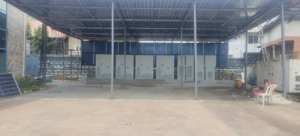
In an implemented project in Nigeria, we adopted a classic power conversion control matrix consisting of a 125kW energy storage unit + 500kW PCS cabinet + 360kW MPPT cabinet.
The MPPT focuses on maximum power point tracking for PV generation. The Mars series PCS supports both grid-connected and off-grid grid-forming operation, as well as 100% three-phase unbalanced load operation, making it suitable for highly demanding phase-unbalanced loads in industrial environments. STS and ATS equipment respectively handle millisecond-level power switching and coordination with the diesel generator.
The biggest challenge in such projects is often not calculating the total equipment power, but controlling the operating sequence and suppressing oscillations among multiple power sources after the system enters off-grid operation.
As a microgrid electrical hub solution provider, YUNT provides global project partners with comprehensive references for dispatch strategies, protection setting recommendations, and communication point lists. We leave complex control sequences to the underlying hardware and firmware, allowing project partners to focus on their EPC and local delivery capabilities, significantly shorten commissioning cycles, and deliver green-power microgrid systems designed to keep end-user factories operating without power interruptions.
For factories that need coordinated PV, storage, diesel, and grid operation, the right control architecture is as important as the installed power capacity. YUNT can be contacted via WhatsApp (+86 137 1503 3530) to discuss your project requirements.