
In Nigeria and other parts of West Africa, highly unstable public grids have led many industrial and commercial projects to rely heavily on diesel generators as their primary power source. Rising fuel costs, frequent maintenance, and equipment degradation caused by low-load operation can place significant pressure on business profitability. A properly designed hybrid microgrid system can coordinate solar PV, energy storage, and diesel generation to reduce dependence on diesel while maintaining reliable power for critical loads.
The Expensive “Diesel Bill” and Uncontrolled Physical Parallel Connection
In Nigeria and other parts of West Africa, the public grid is extremely unstable, and many factories and commercial parks have long relied on diesel generators (DGs) as their primary power source. High fuel costs and frequent scheduled maintenance, combined with carbon buildup and equipment aging caused by low-load operation, directly erode companies’ profit margins.
To replace diesel, many companies have rushed to implement “solar PV + energy storage” projects, but often encounter integration problems on site: physically connecting the PV inverter, battery, and diesel generator in parallel on the AC side. Due to the lack of unified dispatch, sudden PV fluctuations and motor inrushes can easily cause reverse-power trips of the diesel generator and system voltage oscillations. As a result, instead of saving diesel, the entire plant may experience a power outage.
Core Solution: Redefining Power Source Roles for Seamless Solar, Storage, and Diesel Coordination
The engineering goal of a solar-storage-diesel microgrid is not simply to “eliminate the diesel generator,” but to rely on unified microgrid dispatch logic to redistribute the roles of each power source:
- Solar PV Priority:Independent MPPT is used to maximize solar energy utilization and handle the main daytime load.
- Energy Storage Smoothing:The energy storage PCS acts as a dynamic balancing unit. It charges rapidly when PV output suddenly increases and discharges instantly when load surges occur, effectively isolating transient disturbances from the diesel generator.
- Diesel Generator Backup:The diesel generator moves into a secondary role. It is automatically activated by the system only under extreme operating conditions, such as continuous rainy weather, an extremely low battery SOC, and a sudden increase in load.
Standardized 125kW / 500kW Microgrid Configuration
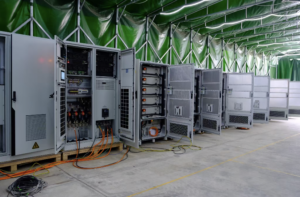
Taking a typical commercial and industrial project we have implemented in Africa as an example, the system uses a 125kW energy storage cabinet with an independent battery connection circuit, a 500kW power conversion system cabinet, and a 360kW MPPT cabinet.
When the utility grid becomes abnormal, static transfer switches and ATS equipment rapidly disconnect the system from the grid. The grid-forming PCS instantly establishes microgrid support. The EMS manages the overall switching sequence and charging and discharging conditions, ensuring the coordinated parallel operation of solar PV, energy storage, and diesel generation while eliminating the risk of reverse power.
This architecture can reduce the diesel generator’s daily operating time by more than 70%, significantly lowering fuel and major overhaul costs.
Dedicated Solution Support: Removing Commissioning Challenges and Enabling Project Deployment
For complex microgrid projects, the main challenges always lie in on-site sequence control and multi-unit coordinated commissioning.
As a microgrid solution provider focused on power conversion and control, YUNT provides customers in Nigeria and around the world with more than just hardware. We provide a mature engineering system. Whether you are a project developer, EPC contractor, or distribution partner, we provide detailed topology drawings, recommended protection settings, and commissioning guidance for reverse power prevention and black start, helping address common on-site issues such as diesel-storage system oscillation.
We package the complex underlying technologies so that customers only need to leverage their local delivery capabilities to quickly and safely deploy high-return solar-storage-diesel microgrid projects.
Planning a solar-storage-diesel microgrid project in Nigeria or another region with an unstable grid? Connect with the YUNT sales and engineering team to discuss your project requirements and system configuration. For solution consultation and technical support, reach us on WhatsApp (+86 137 1503 3530).