
Mining operations in the Andes of Chile and Peru often face extreme environmental and electrical conditions. At altitudes above 4,000 meters, mining sites may be far from the main grid while still requiring reliable power for drainage, ventilation, ore crushing and processing, and worker camps. In such environments, the selection and operation of an energy storage inverter must account for both reduced air density and degraded insulation performance.
The Double Challenge of High Altitude: Thin Air and Insulation Degradation
In the Andes of South America, many large mining areas are located at altitudes above 4,000 meters. These sites are not only far from the main grid but also require strong, uninterrupted power around the clock for drainage, ventilation, ore crushing and processing, and worker camps.
For power electronics equipment, high-altitude environments create two critical challenges.
First, air density drops sharply, significantly reducing heat dissipation efficiency. A conventional air-cooling system that performs well at low altitudes can become much less effective at 4,000 meters. This can easily cause core power devices such as IGBTs to overheat.
Second, the insulating capability of air decreases significantly. Lower atmospheric pressure reduces the breakdown voltage of air, meaning that the original electrical clearances and creepage distances may no longer provide sufficient safety margins. This can easily lead to arcing, insulation breakdown, and protection misoperations, potentially shutting down the entire microgrid power supply system.
If equipment designed for low-altitude environments is simply transported to a high-altitude site, it can easily fall into a cycle of frequent thermal derating and unexpected shutdowns. In addition, in mining areas that rely entirely on diesel generation, the starting impact of heavy motors is borne directly by the diesel generators, significantly shortening their service life.
In a PV-storage-diesel microgrid, the grid-forming PCS must absorb transient power fluctuations and maintain stable microgrid frequency under weak-grid and off-grid conditions.
Core Solution: High-Altitude-Specific Design and Clear Derating Algorithms
When selecting a PCS for a high-altitude mining project, project teams cannot focus only on the “rated power” shown on the nameplate. Two key indicators must be confirmed: Has the equipment been verified under actual high-altitude operating conditions? Does it have a clear underlying altitude-to-power derating control algorithm?
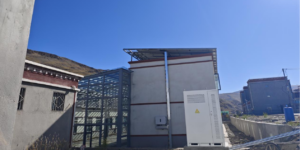
YUNT’s products have completed actual operating verification in an extremely high-altitude project at 4,200 meters on the Qinghai-Tibet Plateau in China. The Mars series PCS has been specially optimized for high-altitude applications, with increased electrical safety distances, enhanced cooling-duct design, and a dedicated dynamic derating strategy for high-altitude operating conditions.
These measures are designed to ensure that the equipment can continue to operate safely and stably and deliver the maximum possible output under low-air-density conditions, without causing overheating or burnout.
For large-scale mining operations, we focus on independent operating areas, large pumping stations, and maintenance workshops, with 500kW–2MW modular microgrid solutions as a primary offering. This approach can also support the deployment of industrial energy storage systems in demanding mining environments where stable power supply is essential.
For Global Project Partners: Avoiding Engineering Risks in Extreme Environments
As a global microgrid electrical hub solution provider, YUNT can provide project partners in Chile, Peru, and other high-altitude regions with a robust hardware foundation based on PCS, MPPT, and STS equipment.
We provide detailed considerations for high-altitude project design, actual derating curves, and environmental adaptation recommendations, helping customers address common on-site risks such as equipment overheating and insulation failure from the outset.
Project partners can leverage their local engineering and implementation strengths, while we provide strong underlying electrical support to jointly overcome the challenges of delivering microgrid systems in extremely cold and oxygen-deficient high-altitude environments.
For high-altitude mining projects, YUNT can be reached via WhatsApp (+86 137 1503 3530) to discuss project requirements and engineering considerations.