
In oil and gas camps and engineering projects across the Middle East, including Saudi Arabia, the United Arab Emirates, Jordan, and Yemen, daytime temperatures can approach or exceed 50°C, often accompanied by persistent sandstorms. For energy storage inverter manufacturers, these extreme conditions create demanding requirements for stable and continuous operation of energy storage systems.
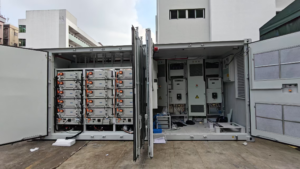
Extreme Desert Conditions: The Deadly Combination of Sandstorms and High-Temperature Derating
In oil and gas camps and engineering projects in Saudi Arabia, the United Arab Emirates, Jordan, Yemen, and other parts of the Middle East, daytime ambient temperatures often approach or exceed 50°C, accompanied by persistent sandstorms. This extreme climate presents a severe challenge to microgrid energy storage systems.
On the one hand, extremely high ambient temperatures can rapidly increase the junction temperature of power devices inside the PCS. To protect themselves, conventional inverters may significantly reduce their output power, a condition known as high-temperature derating. As a result, loads can become unable to operate at the very time when power is most needed at midday, such as when large air-conditioning systems are running for cooling.
On the other hand, air-cooled equipment needs to draw in large amounts of outside air for heat dissipation. Fine sand that penetrates almost everywhere can quickly block cooling channels and dust filters, further accelerating the deterioration of the cooling system. In addition, drilling rigs and pump units used in oil and gas operations often have significant load fluctuations. Equipment must therefore maintain continuous full-power output under the combined pressure of high temperatures, sandstorms, and impact loads.
Core Solution: Wide-Temperature Hardware and High-Power Liquid Cooling or Intelligent Air Cooling
Equipment selection cannot rely simply on a statement in a specification sheet that the “maximum operating temperature is 50°C.” Engineering teams must carefully examine the derating curve and thermal management strategy under prolonged full-load operation at high temperatures.
Wide-temperature operation and a liquid-cooling foundation: YUNT’s Mars series power conversion modules support operation across a wide temperature range. For the Middle Eastern desert environment, we strongly recommend a liquid-cooling architecture. The liquid-cooling plate is directly attached to heat-generating components, allowing heat to be removed efficiently and significantly reducing power losses caused by high ambient temperatures. More importantly, the liquid-cooling circulation system does not require extensive heat exchange with dusty outside air, greatly reducing the amount of dust entering through fans and substantially lowering the cleaning and maintenance burden in desert environments.
Multi-source microgrid coordination: In typical PV-storage-diesel hybrid architectures deployed in the Middle East, such as the wind-PV-diesel-storage project in Yemen and the DC supercharging station in Jordan, the energy storage PCS must not only withstand high temperatures but also handle complex power conversion. Our grid-forming PCS can continue to operate reliably with diesel generators under high-temperature conditions, providing strong voltage and frequency support for drilling rigs, heavy-duty pump units, and air-conditioning loads at camps.
As a microgrid electrical hub solution provider, YUNT Power’s practical projects have been deployed around the world. Our equipment and solutions have successfully served dozens of countries across Europe, including the United Kingdom, Germany, Spain, Italy, the Netherlands, Belgium, Switzerland, Austria, the Czech Republic, Slovenia, Romania, Bulgaria, Moldova, Ukraine, Poland, Lithuania, Latvia, Estonia, Finland, Sweden, Denmark, Hungary, and Cyprus; Africa, including South Africa, Nigeria, Zambia, Zimbabwe, Madagascar, and Cameroon; the Middle East and Asia-Pacific, including Yemen, Jordan, Palau, India, Myanmar, South Korea, Thailand, Vietnam, Malaysia, Singapore, and the Philippines; and South America, including Brazil.
We provide a complete engineering foundation covering modular PCS hardware, EMS dispatch logic, load-splitting solutions, and system electrical topology. Customers can leverage their local delivery and resource advantages while entrusting complex power-conversion control challenges to us, enabling them to deliver resilient energy systems that balance economic efficiency with high reliability.
Planning a microgrid for an oil and gas camp or other high-temperature desert application? Reach out to YUNT via WhatsApp (+86 137 1503 3530) to discuss the project’s operating conditions and power requirements.